 tokki
Talk To Me In Korean & LingoDeer Alternatives (2026): Apps Compared
Looking past Talk To Me In Korean or LingoDeer? Compare the best alternatives in 2026: Tokki, Pimsleur, Duolingo, Memrise, and more, by how you like to learn.
The best alternative to Talk To Me In Korean (TTMIK) or LingoDeer depends on what your course is not giving you. If you want real Korean at natural speed, use Tokki: you scroll short clips from Korean creators and tap any word. If you want to speak out loud, use Pimsleur, or italki for a live tutor. If you want a free daily habit, use Duolingo. If TTMIK feels too long, try LingoDeer. If LingoDeer feels too light on explanations, try TTMIK.
Both courses are good. Most learners do not need to quit them. They need a second tool for the part a course cannot cover: Korean that was not written for a lesson.
We make Tokki, so it comes first in each list. Each section says who the app suits, including when it is not ours. We checked every other app on its official site or store page in November 2026.
TTMIK and LingoDeer in one minute
Talk To Me In Korean is a school that teaches only Korean, and it has been teaching since 2009. Its course site lists more than 1,700 structured lessons, from Beginner to Advanced. Each lesson has four steps: a warm-up, the lesson, speaking practice, and a review quiz. TTMIK also publishes books and podcasts, and runs a popular YouTube channel. You can try Core Grammar 1 for free, and the Standard plan comes with a 7-day free trial.
LingoDeer is a course app for 20 languages, and Korean is one of them. Its App Store page says it is customized for Asian languages. The curriculum is grammar-based: each lesson adds one point, with tips and notes inside the lesson and audio from native speakers. Flashcards, quizzes, and short stories with captions help you review. The alphabet, Unit 1, and the Travel Phrasebook are free. The rest of the course, and offline learning, need a membership.
| Talk To Me In Korean | LingoDeer | |
|---|---|---|
| What it is | A Korean-only school: lessons, podcasts, books | A course app for 20 languages, Korean included |
| How it teaches | Levels of lessons explained in English | One grammar point at a time, with notes and drills |
| Best for | Learners who want the "why" in depth | Learners who want short lessons in a clear order |
| Free to try | Core Grammar 1, then a 7-day trial on the Standard plan | The alphabet, Unit 1, and the Travel Phrasebook |
| What it leaves to you | Finding real Korean to watch | Finding real Korean to watch |
The short version: TTMIK suits a learner who likes a teacher's voice. LingoDeer suits a learner who likes a game-like path. Both teach you Korean that was written for a lesson.
Why people look for alternatives
Neither course is broken. People look for something else when they hit one of these walls.
- Course audio is not real speech. Lesson audio is clear and paced for learners. That is its job. A vlog or two friends in a café are faster. Sounds blend, endings get short, and nobody waits for you.
- The course picks the words. A curriculum has to decide what comes next. You cannot add the word you just heard in a drama to your lesson plan.
- The pace feels like homework. TTMIK lessons explain a lot, and that takes time. LingoDeer lessons drill a point until it sticks. Some days you want Korean, not class.
- You want someone to answer. TTMIK lessons include a speaking step, and LingoDeer has short stories with captions. Neither one gives you a person who replies.
- You want each tool to do a different job. Most of both courses sits behind a subscription. If you already pay for grammar, the next tool should cover something else.
A course is good at structure. The alternatives below fill the gaps around it.
Best alternatives to Talk To Me In Korean
Tokki
Tokki is an app to learn Korean from real video, on iPhone and Android. You scroll a feed of short clips from Korean creators. The subtitles are split into words. Tap any word to see the meaning, hear how it sounds, see it broken into parts, read an explanation, and look at examples. Save it in one tap.
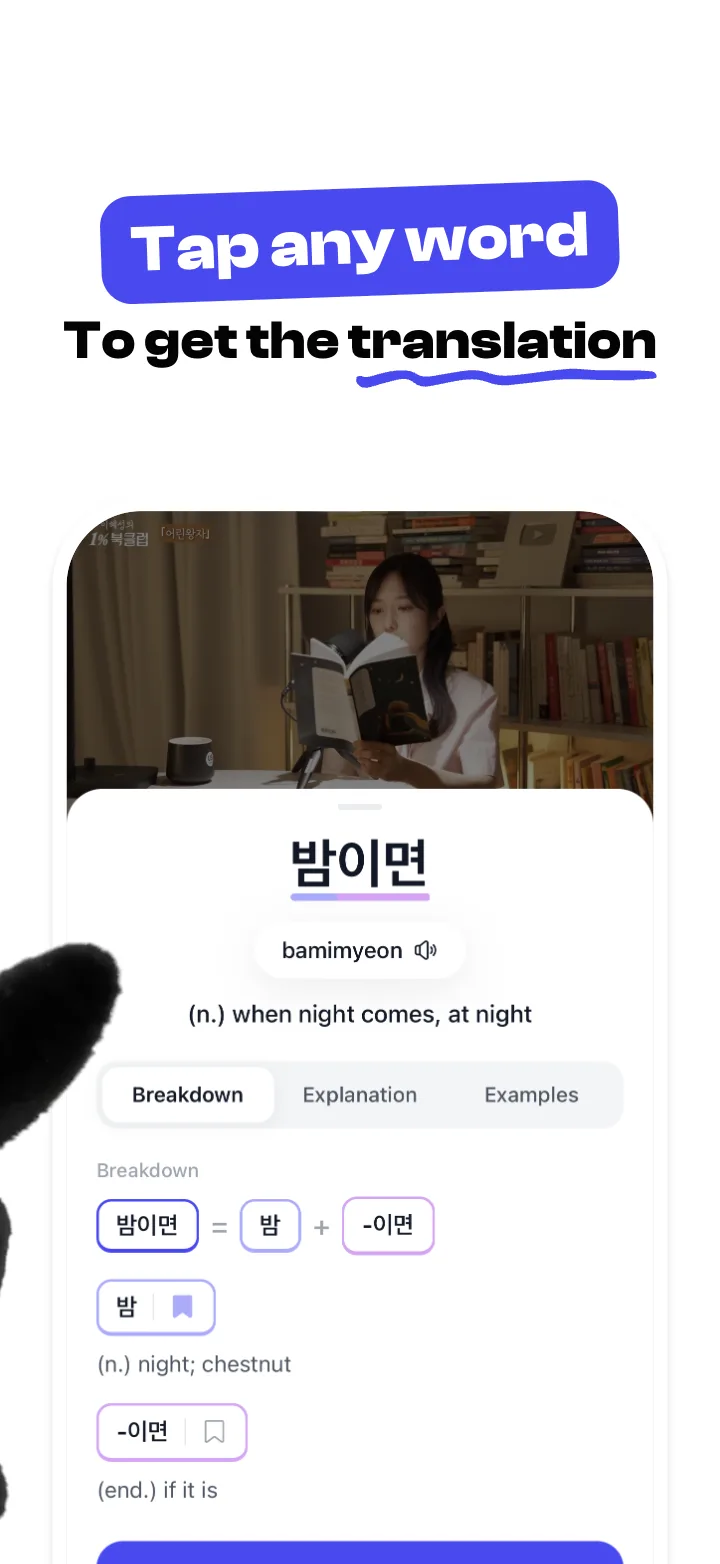 Tap a word in a clip: 밤이면 splits into 밤 and -이면.
This is where Tokki and TTMIK fit together. A grammar lesson teaches you that -면 means "if" or "when." In a Tokki clip, you hear 밤이면 at full speed, tap it, and see 밤 (night) plus -이면 (if it is). The rule becomes a word you can catch.
Best for: TTMIK learners who understand the lessons but miss words in real Korean.
Keep in mind: Tokki does not teach grammar chapter by chapter, and it does not ask you to speak. It is free for 7 days with full access, then a monthly or yearly plan through the App Store or Google Play. There are no ads.
LingoDeer
If TTMIK lessons feel long, LingoDeer is the closest swap. It is still a course with grammar in order. The difference is the format: notes, drills, and quizzes in place of a teacher who talks you through each point. The free Unit 1 lets you test the style before you pay.
Best for: learners who want structure but prefer tapping through exercises to listening to an explanation.
Keep in mind: you trade some depth for speed. The audio is course audio: clear, and slower than real speech.
Pimsleur
Pimsleur Korean is an audio course. Each lesson takes about 30 minutes. You listen, answer out loud, and recall a line before you hear it again. Pimsleur says its method uses spaced repetition, and the course teaches the Seoul dialect. The app also has reading lessons and a role-play feature for conversation practice. You can try a free lesson before you buy.
Best for: TTMIK podcast fans who want to speak, not only listen.
Keep in mind: half an hour is a bigger block than a short lesson, and the voices are course speech.
Teuida
Teuida is a speaking-first app for Korean, Japanese, Spanish, and French. You practice everyday lines in first-person scenes and answer out loud. The app gives instant feedback on your pronunciation. A Premium plan unlocks all the content.
Best for: learners who know some Korean from lessons and freeze when they have to say it.
Keep in mind: it is built for speaking practice. Grammar depth stays with your course.
italki
italki is a marketplace of tutors. You pick a Korean teacher, book an online lesson, and pay per lesson. The price depends on the tutor's rate, and many tutors offer a trial lesson.
Best for: anyone who wants a real person to answer back.
Keep in mind: a tutor gives you conversation, not a curriculum. Bring your own plan, or ask the teacher for one.
Best alternatives to LingoDeer
Tokki
LingoDeer gives you flashcards and quizzes for the words the course teaches. Tokki gives you review for the words you choose. You save a word from a clip, and Tokki brings it back on a review card at the right time. You mark it Again, Hard, Good, or Easy, and spaced repetition decides when you see it next.
A lock screen widget shows your saved words. So you review a word you heard in a real clip each time you pick up your phone, not only when you open a lesson.
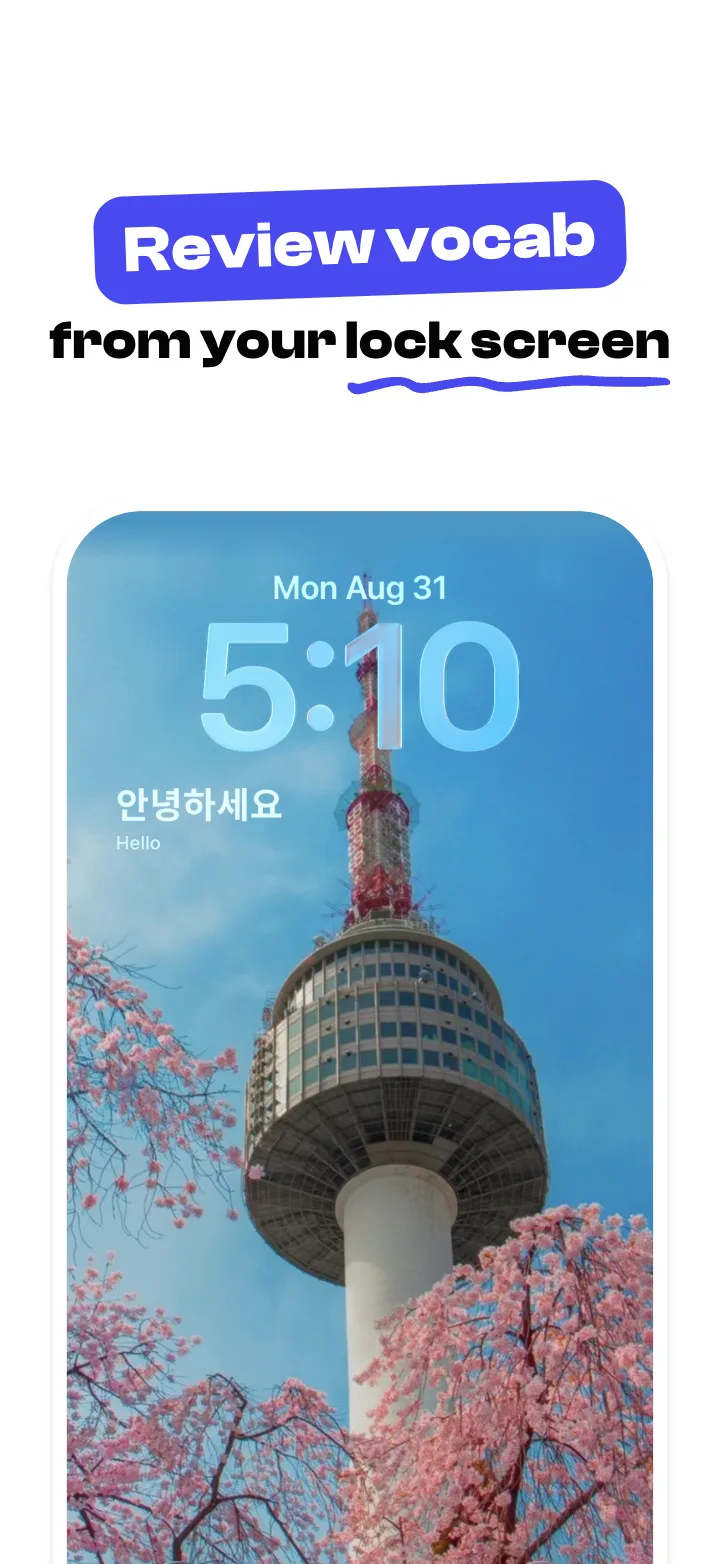 Saved words show up on your lock screen, so you review when you pick up the phone.
Best for: LingoDeer learners who finish units but cannot follow a real Korean clip yet.
Keep in mind: Tokki has Hangul lessons and streaks, but no grammar chapters. Keep LingoDeer or TTMIK for that.
Talk To Me In Korean
If LingoDeer's notes leave you with questions, TTMIK is the natural next step. Every lesson is about Korean only, and the explanations go into the why: particles, politeness, and sentence endings. Lessons work on web and mobile, and the podcasts work on a walk. Try Core Grammar 1 for free, or the 7-day trial on the Standard plan.
Best for: learners who want more depth than a game-like course gives.
Keep in mind: it is still a course. You get structured lessons and lesson audio, not a feed of real Korean.
Duolingo
Duolingo Korean is free. The lessons take a few minutes, and the course has its own Hangul section for reading practice. The streak is good at one job: getting you to open the app tomorrow.
Best for: a free daily habit, or a LingoDeer learner who wants to keep going without a membership.
Keep in mind: Duolingo uses one lesson style for many languages, so Korean grammar gets short notes. If grammar is why you chose LingoDeer, that is a step back. Our guide to Duolingo alternatives for Korean covers its limits.
Memrise
Memrise teaches Korean vocabulary with audio from native speakers and thousands of short video clips. The clips come from sources such as YouTube and TikTok and use the words you just learned. MemBot, an AI language partner, lets you practice role-plays, such as talking to a barista in Seoul. The free plan has a limited number of videos and conversations. Memrise Pro unlocks all features and removes ads.
Best for: vocabulary with a bit of real-world listening, and low-pressure speaking practice.
Keep in mind: the clips are matched to your word list. You do not pick the Korean you watch.
Structured course vs real speech: which fits you?
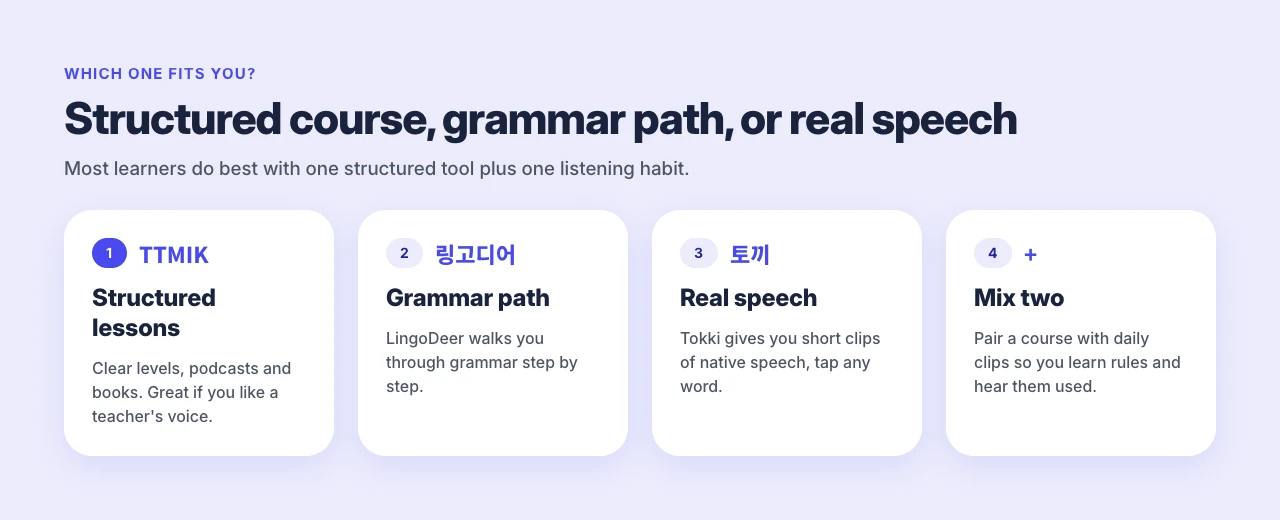 Most learners do best with one structured tool plus one listening habit.
Pick by the thing you lose most often.
- You lose the rule. You hear a sentence and do not know why it ends that way. You need a structured course: TTMIK if you like a teacher who explains, LingoDeer if you like exercises.
- You lose the sound. You know the words on paper, but at full speed they blur. You need real speech: Tokki.
- You lose the words when you speak. You understand, but you cannot answer. You need speaking practice: Pimsleur, Teuida, or a tutor on italki.
- You lose the habit. You stop for a week and do not come back. You need short daily sessions: Duolingo, or a few Tokki clips with saved words on your lock screen.
Most learners lose more than one, so the fourth card says "mix two." A course gives you the rules, and real speech lets you hear them used.
Try Tokki free: pair your course with real Korean.
Mix and match: a simple combo
You do not need five apps. You need three jobs covered:
- One course for grammar in order: TTMIK or LingoDeer.
- Daily clips for listening at real speed: Tokki.
- Review for the words you saved, so they stay.
Here is a sample week at about 20 to 30 minutes a day:
| Day | Course | Clips | Review |
|---|---|---|---|
| Mon | One lesson | 5 minutes | Cards that are due |
| Tue | Rest | 15 minutes, save new words | Cards that are due |
| Wed | One lesson | 5 minutes | Cards that are due |
| Thu | Rest | 15 minutes | Cards that are due |
| Fri | One lesson | 5 minutes | Cards that are due |
| Sat | Speaking: Pimsleur or a tutor | One longer video | Cards that are due |
| Sun | Rest | Rest | Lock screen only |
Three habits make the combo work:
- Look for this week's lesson in your clips. When an ending from your course shows up in a real sentence, tap it. The lesson stops being a page in a book.
- Keep review short. Do the cards that are due, then stop. Five honest minutes beat a long session you skip.
- Do not save every word. Save the ones you hear twice, and the ones you want to say yourself.
Still learning the alphabet? Start with how to read Hangul, then add a course. For a full plan from the first letter to real conversations, read the best way to learn Korean. For the wider list, see the best apps to learn Korean in 2026 and the best free Korean learning apps.
Frequently asked questions
Is Talk To Me In Korean good for beginners?
Yes. TTMIK starts at Level 1 for complete beginners and explains each point in English, step by step. You can try Core Grammar 1 for free, and the Standard plan has a 7-day free trial. Learn Hangul first so you can read the examples. Then add a listening habit, such as short clips in Tokki, so you hear the same grammar at natural speed.
Is LingoDeer better than Duolingo?
For Korean grammar, yes for most learners. LingoDeer's curriculum is grammar-based, with notes inside each lesson. Duolingo is better as a free daily habit, because its Korean course is free. LingoDeer is free only for the alphabet, Unit 1, and the Travel Phrasebook. Many learners use Duolingo for the streak and LingoDeer for the grammar.
What is an app like LingoDeer but with real conversations?
It depends on whether you want to hear real Korean or speak it. To hear it, use Tokki: you watch short clips of Korean creators talking at natural speed and tap any word you miss. To speak, use Teuida for practice scenes with pronunciation feedback, Memrise's MemBot for AI role-plays, or a tutor on italki for a live person.
Can I use TTMIK and Tokki together?
Yes, and they cover each other's gaps. TTMIK teaches grammar in order and explains why a sentence works. Tokki gives you real Korean clips where you tap a word, see its parts, and save it for review. Do a TTMIK lesson, then watch a few clips and look for the same ending or word. Tokki is free for 7 days on iPhone and Android.