 tokki
The Best Apps to Learn Korean in 2026 (Honest Comparison)
What is the best app to learn Korean in 2026? Compare Tokki, Duolingo, Talk To Me In Korean, LingoDeer, and Pimsleur, including the best free options.
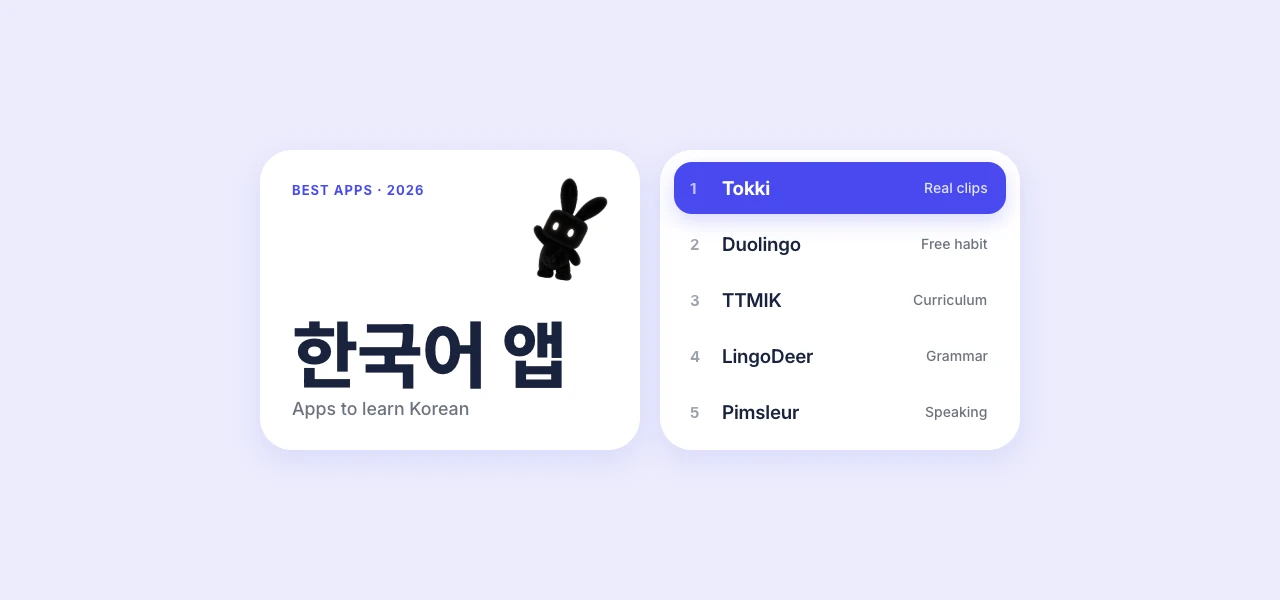
The best app to learn Korean in 2026 depends on how you study. These are the five apps to learn Korean that cover the main jobs: real clips, a free habit, a Korean curriculum, grammar, and speaking.
- Tokki is the best app to learn Korean from real video. You scroll short clips, tap any word for the meaning and the sound, and review it later so it stays.
- Duolingo is the best free start. Duolingo Korean is a short daily lesson, and the core course is free.
- Talk To Me In Korean is the best Korean learning app when you want lessons and a podcast written only for Korean.
- LingoDeer is the best app for grammar taught in order, the way a class would teach it.
- Pimsleur is the best app if you learn by listening and speaking, with the phone in your pocket.
When you want a person on the other side, add italki. It is a marketplace of tutors. You pay per lesson, and the price depends on the teacher.
We make Tokki, so it leads this list. The notes below say what each app is for, including ours. If another one fits your week better, use that one.
Compare the apps
The cost column is the shape of the plan, not a quote. What you pay changes by country and by store.
| App | Best for | You spend your time on | What it costs |
|---|---|---|---|
| Tokki | Real Korean clips | Watching, tapping words, review | 7 days free, then a plan |
| Duolingo | A free daily habit | Short lessons | Free core course, paid plan optional |
| Talk To Me In Korean | A Korean curriculum | Lessons and podcasts | Free material to start, membership for more |
| LingoDeer | Grammar in order | Course lessons and notes | Opening lessons to try, then a plan |
| Pimsleur | Speaking by ear | Audio lessons of about 30 minutes | Paid course |
Tokki
Tokki is an app to learn Korean on iPhone and Android. You scroll a feed of short videos from Korean creators. The subtitles are split into words. Tap a word and you see what it means, hear how it sounds, and see how it is built. Save it in one tap. Tokki brings that word back at the right time, on a review card you mark Again, Hard, Good, or Easy.
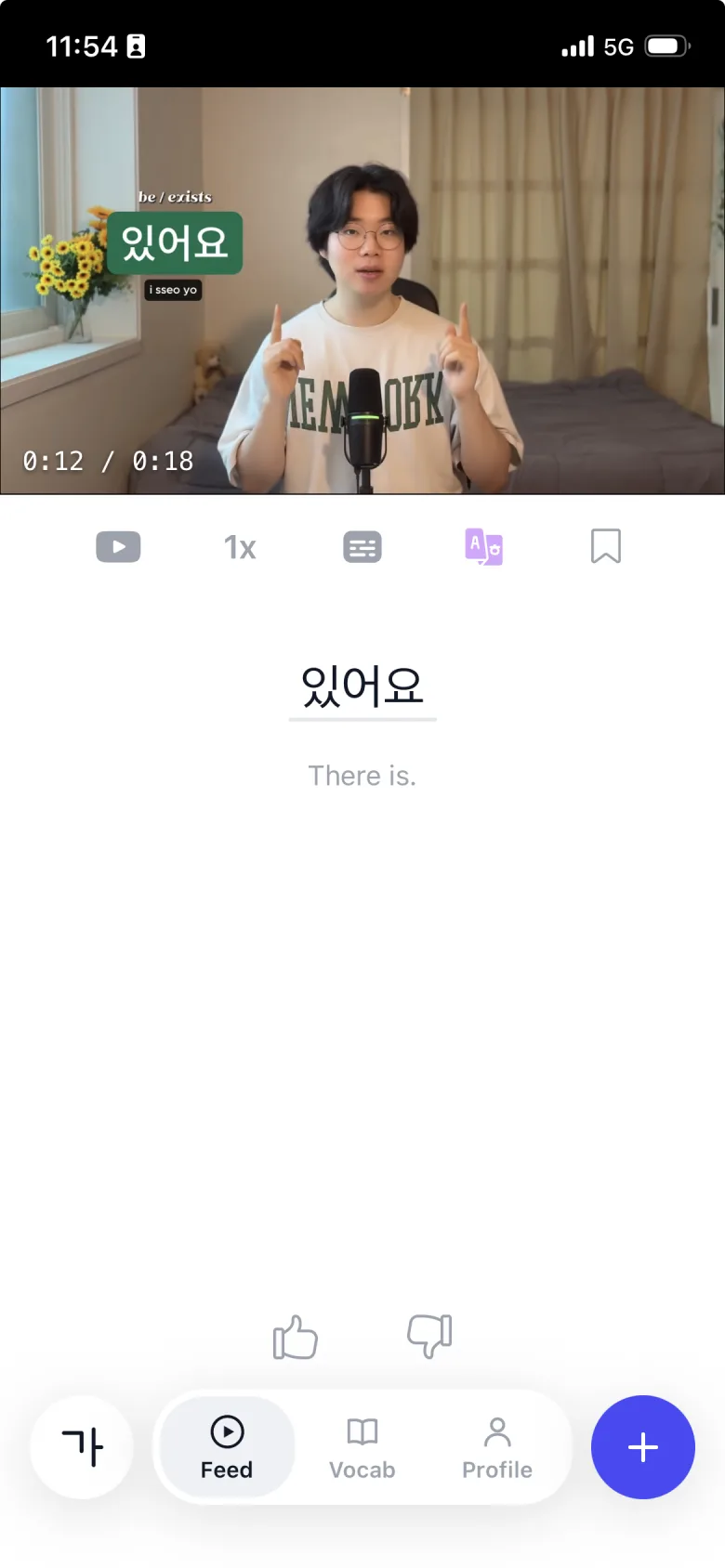 Tap any word in a clip to see what it means.
New to the alphabet? Short Hangul lessons let you trace each letter, hear its sound, and match it in a quick game. A small bunny, also called Tokki, keeps your streak.
Your first 7 days are free. Download Tokki on iPhone or Android. After the trial, you choose a monthly or yearly plan and pay through the App Store or Google Play. The price depends on your country.
Best for: people who can read a textbook line and then miss the same word in a real clip.
Strengths
- Real clips, with every word tappable.
- Review that brings each saved word back at the right time.
- Hangul lessons in the same app, so you can start before you read fluently.
Limitations
- After the 7-day trial, Tokki is a paid plan.
- The path is clips, saved words, and review. For grammar taught chapter by chapter, add Talk To Me In Korean or LingoDeer.
- You are not asked to speak into the phone. Speaking practice lives in Pimsleur or a lesson with a tutor.
Duolingo
Duolingo Korean is the course most people try first. A lesson takes a few minutes, a streak asks you to come back tomorrow, and the path starts from zero, including Hangul. The core course is free. A paid plan is there if you want one.
Best for: a free daily habit, and anyone in their first weeks of Korean.
Strengths
- The main course is free.
- Lessons are short enough to finish while the kettle boils.
- A gentle start on Hangul and basic sentences.
Limitations
- Notes stay brief. The same lesson style serves many languages, so Korean grammar gets less room than in a Korean-only course.
- The lines you hear are written for the exercise. Natural speed shows up in clips and podcasts.
- Speaking prompts are short. They are a warm-up. A real conversation still needs another tool.
Talk To Me In Korean
Talk To Me In Korean is a curriculum built only for Korean. Lessons explain grammar in plain English, level by level. The podcast is there for listening when you are away from a screen. Books and a membership sit next to the lessons when you want more practice. You can start with the lessons and episodes they offer at no cost.
Best for: learners who want particles, honorifics, and sentence endings explained properly.
Strengths
- Every lesson is about Korean, so the explanations match how the language works.
- You can listen on a walk, which helps the sounds settle.
- A path from early lessons toward harder listening.
Limitations
- You finish a lesson, then you go find something real to watch. There is no feed of clips.
- A dialogue in a lesson is still practice. A live reply comes from a tutor or a speaking app.
LingoDeer
LingoDeer teaches Korean, Japanese, and Chinese with grammar notes written for those languages. A lesson introduces one point, drills it, and the next lesson builds on it. You can try the opening lessons. The rest of the course is a subscription.
Best for: people who want to know what to study next, in order.
Strengths
- Grammar notes that treat Korean as Korean, including particles.
- A sequence, which helps when a game-style app starts to feel aimless.
- Dialogues and review inside the course.
Limitations
- It feels like class. That suits a learner who wants a class, and it is a mismatch if you only stay consistent while watching something.
- Listening stays inside the course audio. Course audio is clear, and slower than friends talking.
Pimsleur
Pimsleur Korean is an audio course. A lesson runs about 30 minutes. You listen, you speak out loud, and the lesson asks you to recall a line before you hear it again. There is very little to look at, which is why people use it while walking. The course is paid.
Best for: pronunciation and spoken phrases, on a commute or a walk.
Strengths
- You speak in the first lesson, which most tap-the-answer apps save for later.
- The pace leaves room for sounds that are easy to miss, such as a consonant at the end of a syllable.
- Dialogues stay practical: greetings, getting around, simple needs.
Limitations
- Reading is a separate job. Learn the alphabet on its own first.
- A lesson is half an hour, which is a different commitment from a two-minute game.
- The audio is course speech: clear, and slower than a conversation between friends.
How to choose the best Korean learning app
Match the app to the job. A commute wants audio. An evening with a notebook wants grammar. A show you already watch wants subtitles you can tap.
You are starting from zero
Learn Hangul before you collect five apps. The letters are a small system, and once the blocks click you can sound out real words. Learn the letters first, then use Duolingo or LingoDeer for a daily path. Open Tokki when you want those letters inside real subtitles.
The best apps to learn Korean for free
Use Duolingo for lessons and the free Talk To Me In Korean material for explanations. Tokki is free for 7 days, then a plan. The best apps to learn Korean for free are usually this kind of stack. One free app rarely covers lessons, listening, and review together.
You freeze when the Korean is real
Quizzes can feel fine while clips still feel impossible. That gap is listening, with the words attached. Tokki gives you the whole clip. The Talk To Me In Korean podcast gives you lesson audio you can follow from the start.
You want to speak
Use Pimsleur until you can say a few useful lines. Then book a Korean tutor on italki when you want someone to answer. You pay per lesson, and the price depends on the teacher. Keep an app for the days between lessons.
You will only open one learn Korean app
Choose Tokki if you like video. Choose Talk To Me In Korean if you like lessons. Choose Duolingo if the habit has to be free and game-like.
A simple stack
Two apps you open will do more than five you install.
- Grammar: Talk To Me In Korean or LingoDeer.
- Real Korean: Tokki.
- Speaking, when you are ready: Pimsleur or italki.
Frequently asked questions
What is the best free app to learn Korean?
Duolingo is the best free app to learn Korean for most beginners. The core course is free, the lessons are short, and you can start from zero, including Hangul. Talk To Me In Korean is the better free source when you want grammar written only for Korean: start with the lessons and podcast episodes available at no cost, and use the membership when you want the rest. Tokki is free for the first 7 days, then a subscription. A strong free setup is Duolingo plus one Korean-only source.
Is Duolingo good for Korean?
Yes. Duolingo Korean is a good way to start, to learn Hangul, and to keep a daily streak. The main course is free. Treat it as the habit. The grammar notes are short, and the audio is written for the lesson, so add clips or a Korean-only course once you want fuller explanations and more natural speech. Many people keep Duolingo and add Tokki, Talk To Me In Korean, or LingoDeer beside it.
What is the best app to learn Korean for beginners?
Learn Hangul first, then one short lesson a day. Duolingo and LingoDeer are the easiest beginner apps, because they show you the next step. Tokki also has short alphabet lessons: you trace a letter, hear it, and match it in a game, then you can tap words in clips once you can read a little. Beginners do well with one lesson app and one place to hear real Korean.
What is the best Korean learning app for real listening?
Tokki. You scroll short videos from Korean creators, with the subtitles split into words. Tap a word to see the meaning, hear the sound, and see how it is built, then save it for review. Talk To Me In Korean's podcast is the better pick when you want lesson audio you can follow from the start.
Can I learn Korean with an app alone?
You can learn the alphabet, the core grammar, and a large vocabulary from apps. Two kinds of practice still sit mostly outside an app: Korean that was made for Korean speakers, at full speed, and a conversation where someone answers you. A practical setup is one lesson app, one listening habit, and a tutor when you want a live reply. The download starts the work.
Which apps to learn Korean should I use together?
Pair a curriculum with something real. Use Talk To Me In Korean or LingoDeer for grammar, and Tokki for clips and review. Add Pimsleur when speaking is the goal, and italki when you want a teacher. Two apps you actually open will beat a long list of icons.
Download Tokki
If real Korean is the part you have been missing, download Tokki. Watch a clip, tap the words you do not know, and review them before they slip. Your first 7 days are free, on iPhone and Android.