 tokki
The Best Way to Learn Korean in 2026: Immersion vs Drills vs Classes
The best way to learn Korean: read Hangul first, then 15 minutes a day of real listening, spaced review, and speaking out loud. Compare the three methods.
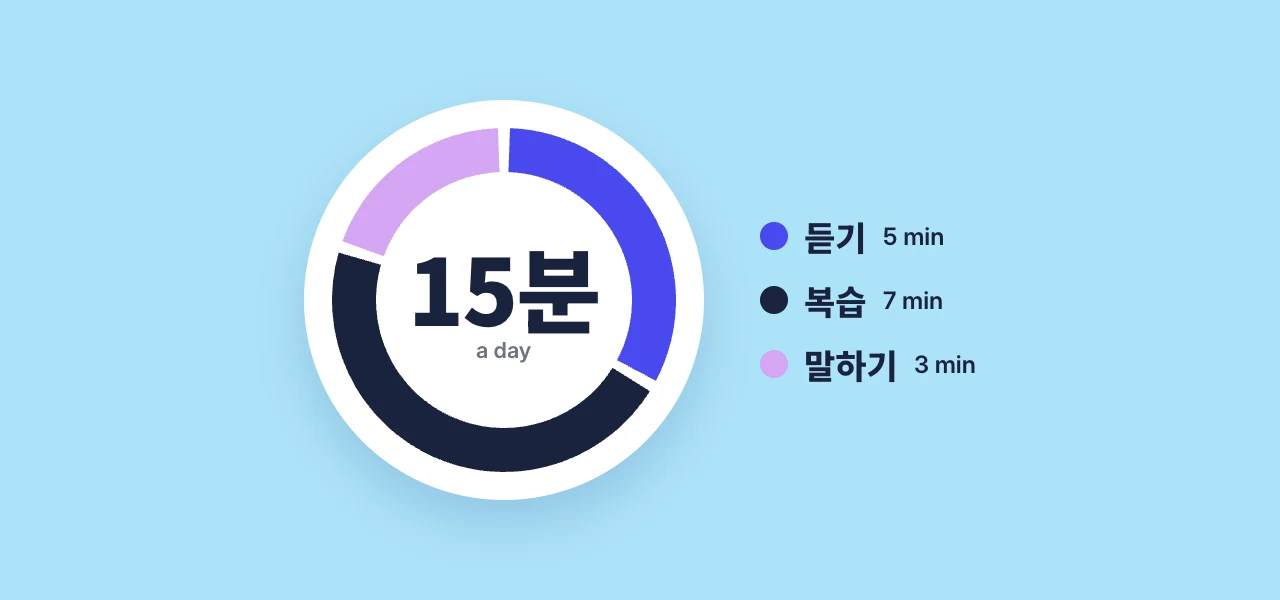
The best way to learn Korean is to learn Hangul first, then spend a short time every day on three things: listening to real Korean, reviewing the new words with spaced repetition, and saying lines out loud. Add one structured source, such as a course, a textbook, or a tutor, for grammar. Fifteen minutes every day will take you further than three hours on a Sunday.
People often frame this as a choice: immersion, drills, or classes. You need all three, each for the job it does best.
We make Tokki, an app for the listening and review part of this routine. This guide says where it fits, and where you need something else.
The short answer
Read Hangul in your first week. After that, listen to real Korean every day, review the words you saved with spaced repetition, and shadow one line out loud. Pick one structured source so grammar comes to you in order. From about week 4, start small talk with a real person.
That gives you a five-step plan:
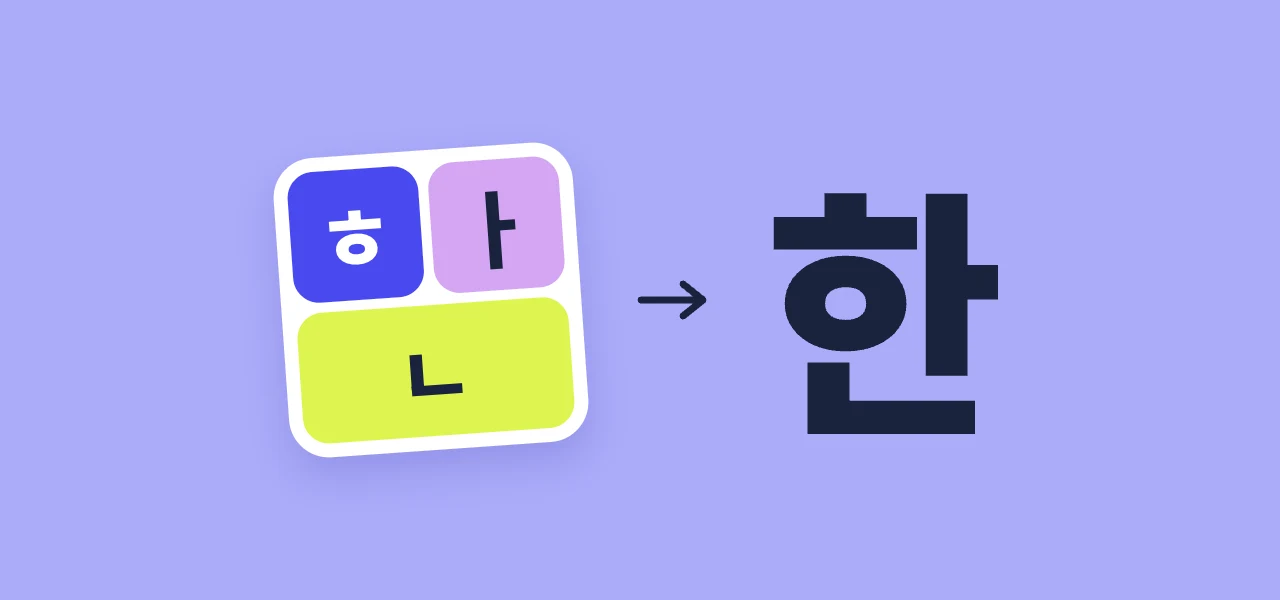
- Read Hangul (week 1). Learn the alphabet before anything else. Our guide to how to read Hangul walks you through it.
- Real listening (daily). Short clips of native speakers at normal speed, made for Korean viewers.
- SRS review (about 10 minutes). SRS stands for spaced repetition system: cards that bring each word back right before you would forget it.
- Shadowing (out loud). Play a line, pause, and say it the same way the speaker did.
- Small talk (week 4 and after). A short conversation with a tutor or a language partner, once or twice a week.
Three ways to learn: immersion, drills, classes
Almost every method you read about falls into one of three groups.
- Immersion is Korean made for Korean speakers: shows, vlogs, podcasts, music, short clips.
- Drills are practice you repeat: flashcards, app lessons, spaced review.
- Classes are any setup where someone else decides the order: a school course, a textbook, a tutor, or a structured app course.
| Method | What it does well | What it misses |
|---|---|---|
| Immersion | Real speed, real words, and the reason you started | No order, hard from zero, easy to watch without learning |
| Drills | Memory, a daily habit, short sessions that fit a busy day | Words without context, audio cleaner than real speech |
| Classes | Grammar in order, clear explanations, feedback on mistakes | Slow pace, fixed schedule, little real-speed listening |
Immersion
Immersion trains your ear. Real Korean is fast. Sounds run together, endings get short, and people use words that no textbook covers in week one. The only way to get used to that is to hear a lot of it.
The weak spot is the start. Immersion does not teach much on its own when you know nothing. If you watch a two-hour drama with English subtitles, you mostly read English for two hours. You need some words, and a way to catch new ones, before immersion starts to work.
Drills
Drills make words stay. Spaced review is the most useful kind. You see a word, you rate how well you knew it, and the card comes back later. Easy words come back after days. Hard words come back in minutes. You spend your time on the words you are about to lose, not on the ones you already know.
The weak spot is context. Drills can feel like progress while your ear stays behind. You can know hundreds of flashcards and still miss them in a real sentence, because you learned them alone, from clean audio.
Classes
Classes give you order. Korean grammar works very differently from English. The verb comes at the end of the sentence. Small particles mark the topic, the subject, and the object. The ending of a sentence changes with how polite you are. A good course explains these one piece at a time, and a teacher corrects you, which no video can do.
The weak spot is speed. Course dialogues are recorded slowly and clearly, and a class moves at a fixed pace. You can finish a course and still find a real conversation too fast to follow.
So which one wins?
None of them, alone. The best way to learn Korean is a mix: immersion as your main input, drills so you keep what you heard, and one class or course for grammar. The routine below fits the first two, plus a little speaking, into 15 minutes a day.
A simple daily routine (15 minutes)
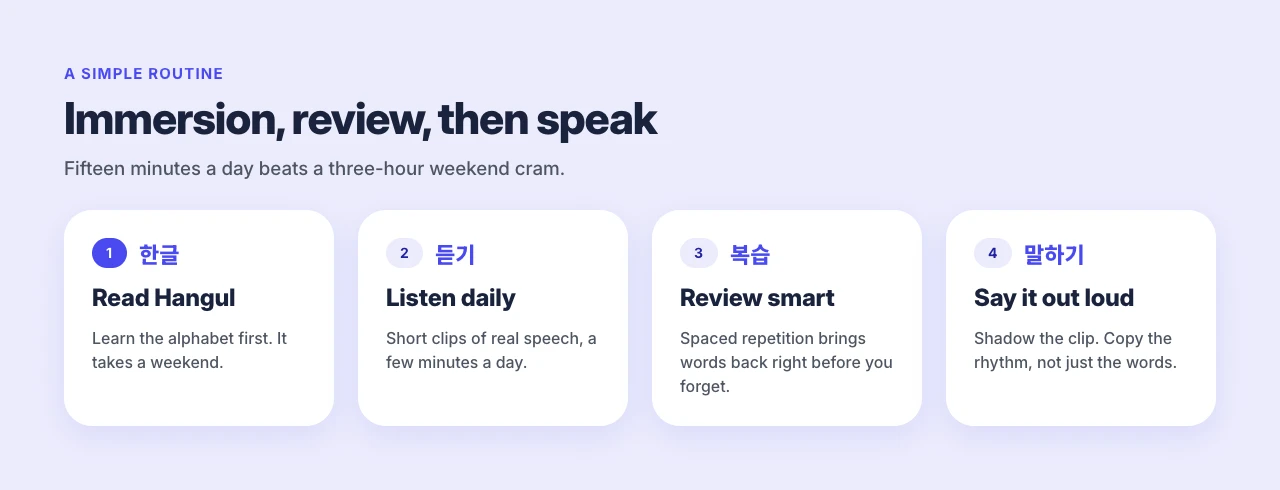 Fifteen minutes a day beats a three-hour weekend cram.
This routine assumes you can read Hangul, even slowly. If you cannot yet, spend your first week on the alphabet. Then do this every day:
| Minutes | Step | What you do |
|---|---|---|
| 0–5 | Listen | Watch two or three short clips. Look up the words you miss. Save three to five of them. |
| 5–12 | Review | Do the cards that are due today. Rate each one honestly. |
| 12–15 | Shadow | Pick one line from a clip. Play it, pause, say it out loud. Repeat five times. |
Listen (minutes 0–5). Pick short clips you would watch anyway: a vlog, a street interview, a cooking video. Watch each clip once without stopping, only to hear the sound. Then watch it again with Korean subtitles and look up the words you missed. Do not save every word. Save the few you think you will hear again.
Review (minutes 5–12). Open your review cards and do the ones that are due. Each card shows a word. Try to recall the meaning before you turn the card. Then rate yourself. In Tokki, you mark Again, Hard, Good, or Easy, and each button shows when the card comes back: for example Again in 1 minute, Hard in 10 minutes, Good in 1 day, Easy in 4 days. With spaced repetition, the gap gets longer each time you remember a word.
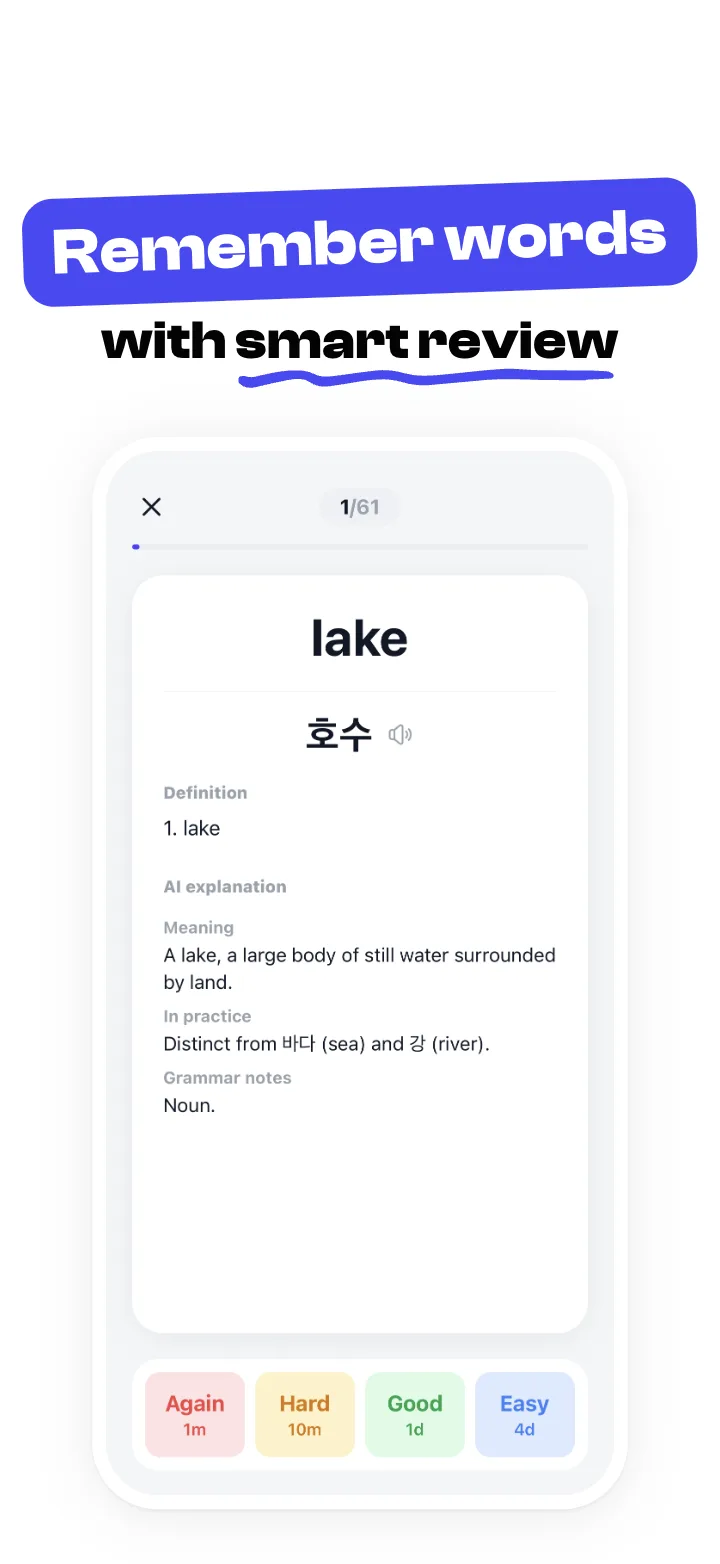 Each button shows when the card comes back.
Be honest when you rate. If you had to think for a while, press Hard, not Good. A card you mark Easy too often comes back days later, when you may not know it anymore.
Shadow (minutes 12–15). Shadowing means you copy a speaker out loud, line by line. Pick one short line from today's clips. Play it, pause, and say it the same way: the same speed, the same rhythm, the same rise and fall. Do it five times. The goal is to train your mouth on real Korean sounds. Any clip you can pause will do.
As your saved words grow, review can take 10 minutes on its own. When that happens, keep the review and save fewer new words for a few days. Review first, new words second.
Do the listening part in Tokki: real clips, tap any word, smart review.
How to learn Korean fast without burning out
Be honest about the timeline
The US Foreign Service Institute (FSI) puts Korean in Category IV, its group of "super-hard languages" for native English speakers. FSI estimates about 88 weeks, or 2,200 class hours, for a student to reach level 3 in speaking and listening on the ILR scale. The US government calls level 3 "General Professional Proficiency." A typical FSI week is 23 hours in class and 17 hours of self-study.
You are probably not studying 40 hours a week. So "fast" in Korean means steady, not quick. Fifteen minutes a day will not make you fluent in three months, and no app or method can promise that honestly. Small wins still come early. You can read Hangul in your first week. After that, the words you review start to stand out in the clips you watch.
Short daily sessions beat weekend cramming
When you see a word again after a gap, you have to pull it back from memory. That small effort is what makes it stick. A weekend cram gives you one long session and six days of forgetting. Fifteen minutes a day gives you seven short sessions, each one a chance to recall what you learned the day before.
Short sessions are also easier to keep. Fifteen minutes fits on a bus ride. On a bad day, do five minutes of review and stop there.
You can also add small review moments across the day. Tokki has a lock screen widget that shows your saved words, so you see one each time you pick up your phone.
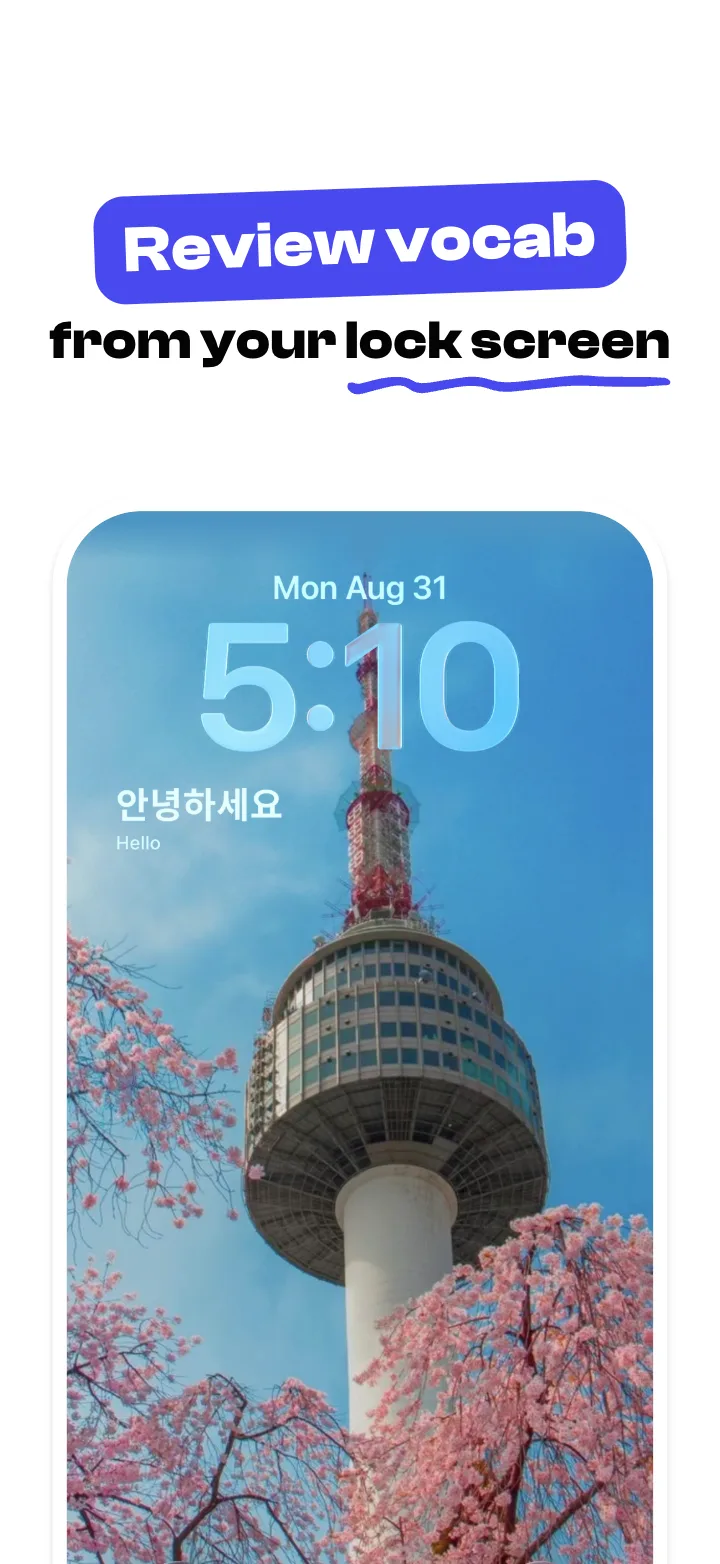 A saved word on your lock screen is one more small review.
Learn the words you will actually hear
A word list by topic, such as colors, fruit, or family, is easy to find. But real speech leans on small words that come up in almost every clip: 진짜 (really), 그냥 (just), 근데 (but, by the way), 너무 (very, too), 뭐 (what). Save the words you hear more than once. Those are the ones that will come back, in the next clip and in your next conversation.
Say it out loud from day one
It is easy to stay silent until you feel ready, and that day keeps moving. Shadowing gives you speaking practice before you are ready for a conversation.
From about week 4, add small talk with a real person: a tutor or a language exchange partner. Keep it short. Say who you are, talk about your day, ask one question. italki is one marketplace of tutors. You pay per lesson, and the price depends on the teacher.
Keep the setup small
A plan that is too big is hard to keep. Five apps, three textbooks, and 50 new words a day will not last. Pick one tool for each part of the routine, and give it a month before you judge it. A streak helps on the days you do not feel like it, as long as a short day counts.
Tools that help (apps, podcasts, clips)
You need one tool for each part of the routine, not ten.
- Listening: short clips from Korean creators. Tokki gives you a feed of them, with subtitles split into words you can tap. YouTube vlogs work too, when they have Korean subtitles.
- Review: a spaced repetition app. Tokki turns the words you save from clips into review cards. Anki works if you like to build your own decks.
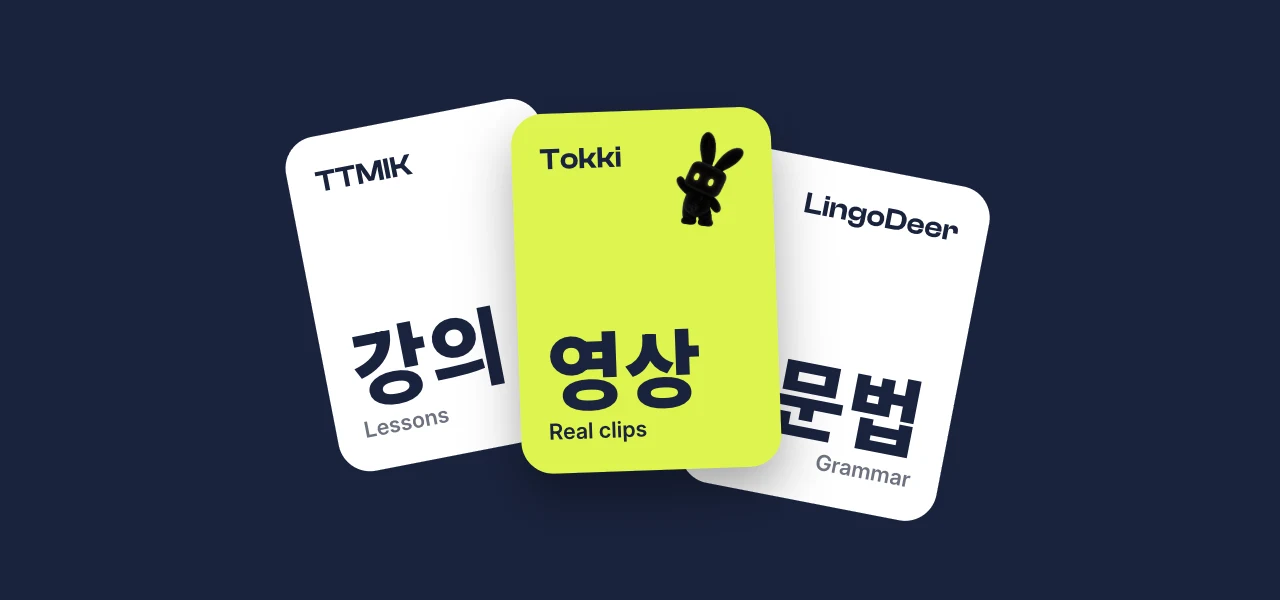
- Grammar: one structured source. Talk To Me In Korean and LingoDeer both teach grammar in order. If neither suits you, see TTMIK and LingoDeer alternatives.
- Audio on the go: a podcast for learners. Talk To Me In Korean has one that explains Korean in English, which suits a walk or a commute.
- Speaking: Pimsleur, an audio course where you answer out loud. A tutor or a language partner gives you a live reply.
We compare these apps in detail elsewhere:
- The best apps to learn Korean in 2026, with a table of what each app is for.
- The best free Korean learning apps, if you want to start without a subscription.
- Duolingo alternatives for Korean, if you finish your lessons and still cannot follow real Korean.
Frequently asked questions
What is the fastest way to learn Korean?
Learn Hangul first, then study every day in short sessions instead of one long session a week. Spend most of that time on real Korean listening, review the new words with spaced repetition, and shadow a line out loud. Add one course for grammar and, after a few weeks, short talks with a tutor or partner. No method removes the hours, but this mix wastes the fewest of them.
How long does it take to learn Korean?
It depends on your goal and your hours. The US Foreign Service Institute puts Korean in its hardest group for native English speakers. It estimates about 88 weeks, or 2,200 class hours, for its students to reach a professional level in speaking and listening, with about 40 hours of class and self-study a week. At 15 to 30 minutes a day, that level takes years, not months. Smaller goals come much sooner: you can read Hangul in your first week and start to pick out common words in real clips.
Can I learn Korean by watching K-dramas?
K-dramas help, but watching alone is not enough. With English subtitles on, you mostly read English. To learn from a drama, watch short scenes, turn on Korean subtitles, look up the words you miss, save them for review, and rewatch the scene. Pair that with a grammar source, and drama becomes a strong listening tool instead of only entertainment.
How many minutes a day should I study Korean?
Fifteen minutes a day is a good minimum, if you do it every day: about 5 minutes of listening, 7 to 10 minutes of review, and a few minutes of shadowing. If you have more time, add more listening first, then grammar. On a busy day, five minutes of review still keeps the habit going.
Try Tokki
If real Korean is the part you are missing, download Tokki. Watch a short clip, tap the words you do not know, and review them before they slip. Your first 7 days are free, on iPhone and Android, with no ads.