 tokki
Duolingo Alternatives for Learning Korean (2026)
Is Duolingo Korean enough? Compare the best Duolingo alternatives for Korean in 2026: Tokki, LingoDeer, Talk To Me In Korean, Memrise, and Pimsleur.
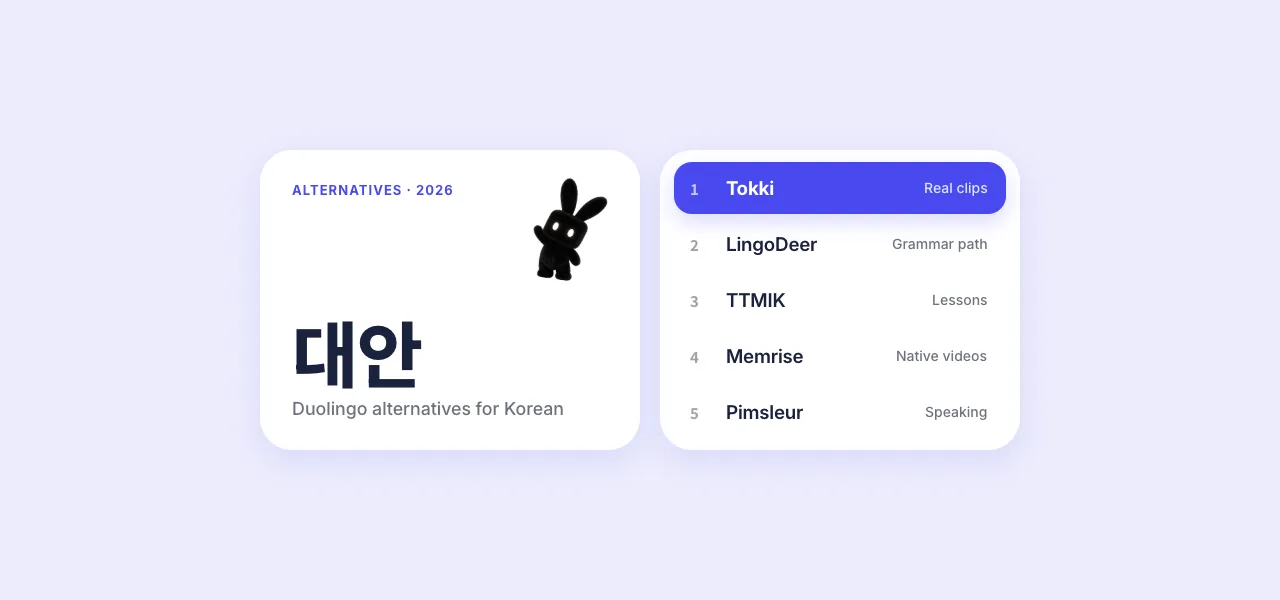
The best Duolingo alternative for Korean depends on what Duolingo is not giving you. If you want real Korean at natural speed, use Tokki: you scroll short clips of Korean speech and tap any word. For grammar in order, use LingoDeer or Talk To Me In Korean. For speaking out loud, use Pimsleur. For vocabulary with native-speaker videos and an AI chat partner, use Memrise.
Duolingo Korean is still a good, free place to start. Most people do not need to quit it. They need a second app for the part it skips.
We make Tokki, so it is first on this list. Each section below says who the app suits, including when it is not ours.
Is Duolingo good for learning Korean?
Yes, for the start. The Duolingo Korean course is free, the lessons take a few minutes, and the path begins with Hangul. The streak is good at one thing: getting you to open the app tomorrow. A paid plan, Super Duolingo, removes ads and gives unlimited hearts. The lesson content is the same on the free plan.
The limits show up after a few weeks:
- The audio is written for the exercise. Sentences are clear and built to test one point. Korean in a show, a vlog, or a conversation is faster and less tidy.
- Grammar notes are short. Particles, sentence endings, and politeness levels are a big part of Korean. A course that serves many languages gives them less room than a Korean-only course does.
- You learn the words the course picks. You cannot grab a word you just heard in a K-drama and add it to your review.
None of that makes Duolingo bad. It makes it a habit tool. If you finish lessons but still freeze when you hear real Korean, the gap is listening, and that needs a different kind of app.
What to look for in a Duolingo alternative
Start with the job you want the app to do.
- Real listening. Native speakers at normal speed, not lines recorded for a quiz.
- Your own words. A way to save the word you just heard and see it again later.
- Review that is spaced. Words come back right before you would forget them.
- Grammar explained for Korean. Notes written for Korean, not shared across 40 courses.
- Speaking. Prompts that make you say whole lines out loud.
- A price you will keep paying. A free trial tells you more than a review does.
No single app does all six well. Two apps that cover each other's gaps usually beat one that does everything halfway.
The best Duolingo alternatives for Korean in 2026
Prices change by country and by store. We checked each app's official site in October 2026. Check the store page before you subscribe.
| App | Best for | How it teaches | Free to try |
|---|---|---|---|
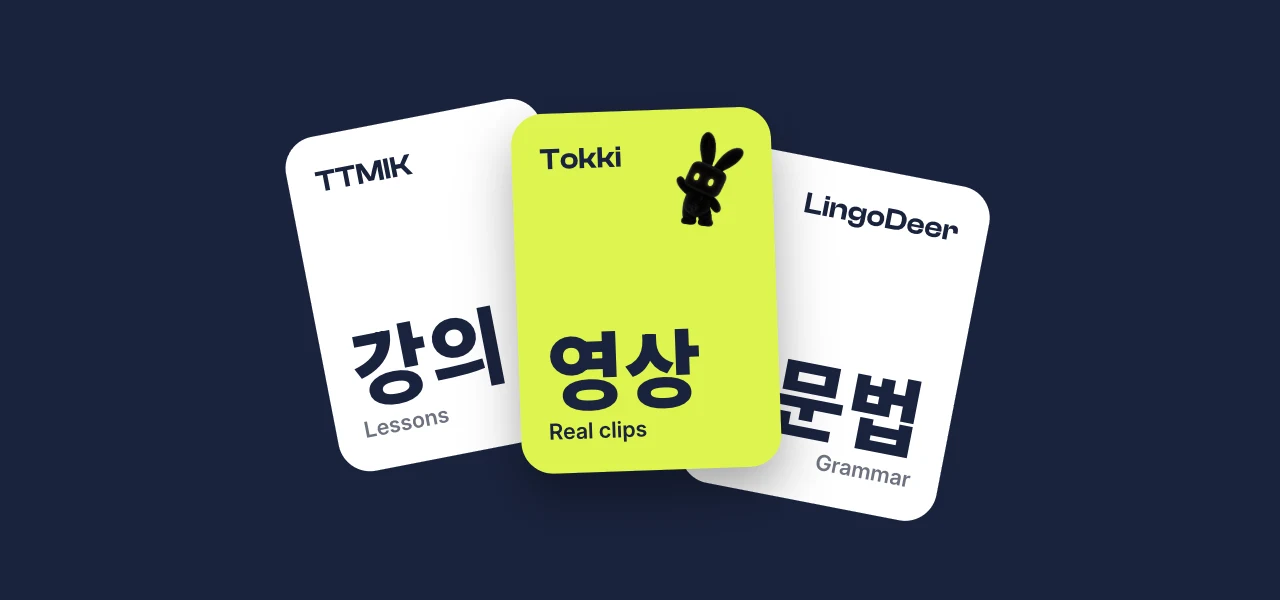
| Tokki | Real listening | Short clips, tap any word, spaced review | 7 days free, then a plan |
| LingoDeer | Grammar in order | Course lessons with grammar notes | Alphabet and Unit 1 free |
| Talk To Me In Korean | Korean explained in depth | Audio and video lessons, level by level | 7-day trial on the yearly Standard plan |
| Memrise | Vocabulary and native-speaker videos | Scenario lessons, videos, AI speaking partner | Free version, Pro for the full app |
| Pimsleur | Speaking by ear | 30-minute audio lessons | 7 days free |
Try Tokki free: learn Korean from short clips of real speech.
Tokki
Tokki is an app to learn Korean from real video, on iPhone and Android. You scroll a feed of short clips from Korean creators. The subtitles are split into words. Tap a word and you see what it means, hear how it sounds, and see how it is built. Save it in one tap, and Tokki brings it back on a review card at the right time.
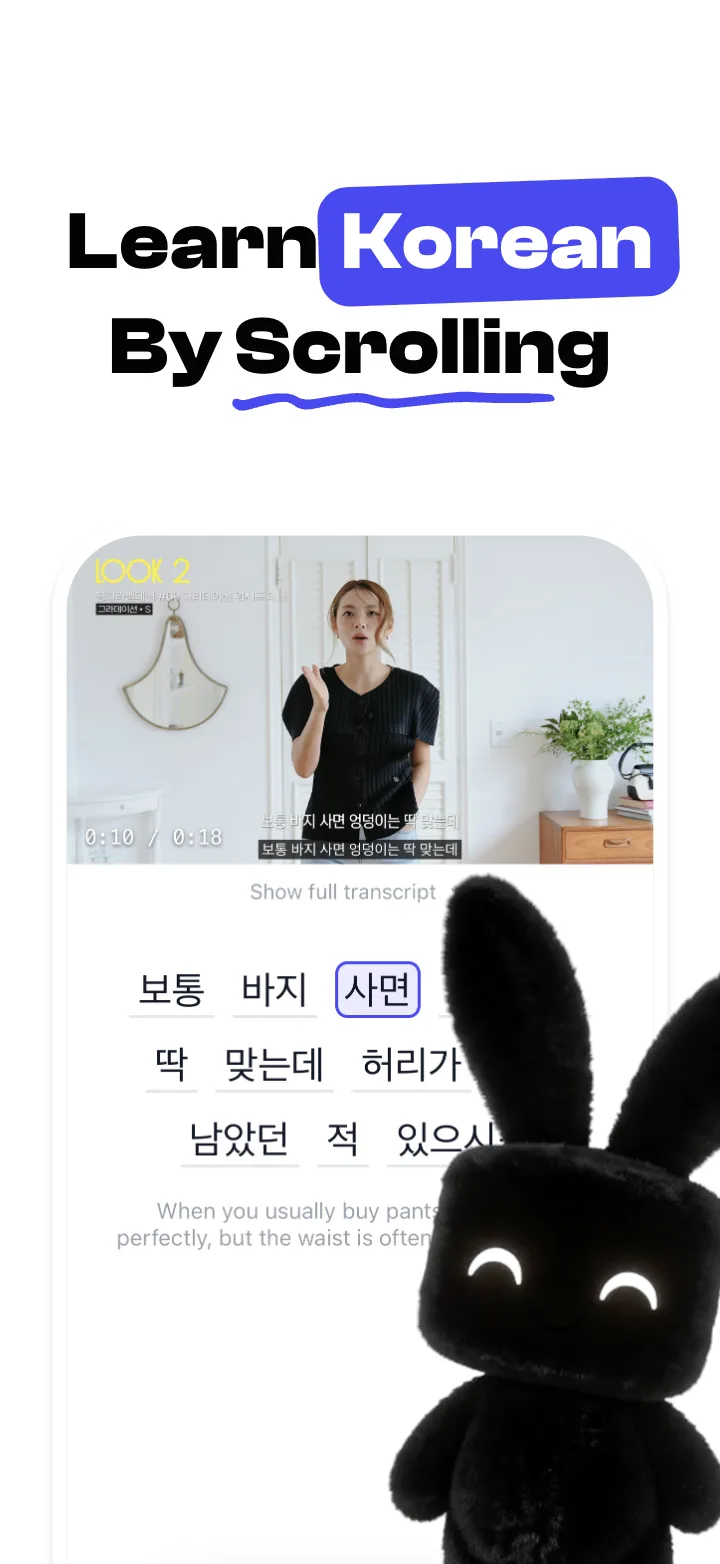 Learn Korean from short clips of real speech.
This is the biggest difference from Duolingo. Duolingo decides which words you learn. In Tokki, you pick them from Korean you actually want to understand. Short Hangul lessons are in the same app if you are still learning to read.
Best for: people who finish Duolingo lessons and still cannot follow a real clip.
Keep in mind: Tokki is free for 7 days, then a monthly or yearly plan through the App Store or Google Play. It does not teach grammar chapter by chapter, and it does not ask you to speak.
LingoDeer
LingoDeer was built for Asian languages, including Korean, Japanese, and Chinese. Each lesson introduces one grammar point, drills it, and the next lesson builds on it. The notes treat Korean as Korean, with particles and endings explained properly. You can try the alphabet, all of Unit 1, and the travel phrasebook for free. The rest of the course needs a membership.
Best for: Duolingo users who want to know why a sentence works.
Keep in mind: it feels like a class, and the audio is course audio. It is clear, but slower than real speech.
Talk To Me In Korean
Talk To Me In Korean (TTMIK) teaches only Korean, with more than 1,700 lessons from beginner to advanced. Lessons explain grammar in plain English, and the audio format works on a walk. The yearly Standard plan comes with a 7-day free trial. On TTMIK's site, plans start at $7.12 a month billed yearly, and monthly is $16.99, before tax.
Best for: learners who want the deepest grammar explanations in English.
Keep in mind: you finish a lesson and then still need to go find real Korean to watch.
Memrise
Memrise teaches Korean through scenarios such as food, travel, and introductions. Words are spoken by native speakers, and short videos show locals using the words you learned. Memrise also has an AI language partner for private speaking practice. There is a limited free version. Memrise Pro unlocks the full app, and the US web price we saw was $24.99 a month, with cheaper yearly plans.
Best for: building practical vocabulary with a bit of real-world listening.
Keep in mind: the videos are short clips matched to your word list, not a feed of Korean you choose.
Pimsleur
Pimsleur Korean is an audio course. A lesson takes about 30 minutes. You listen, answer out loud, and recall a line before you hear it again. There is little to look at, which is why it works on a commute. The first 7 days are free. After that, Pimsleur's US site lists Premium at $19.95 a month for one language.
Best for: pronunciation and speaking from the first day.
Keep in mind: reading is a separate job, and a half-hour lesson is a bigger commitment than a five-minute Duolingo round.
Tokki vs Duolingo: side-by-side
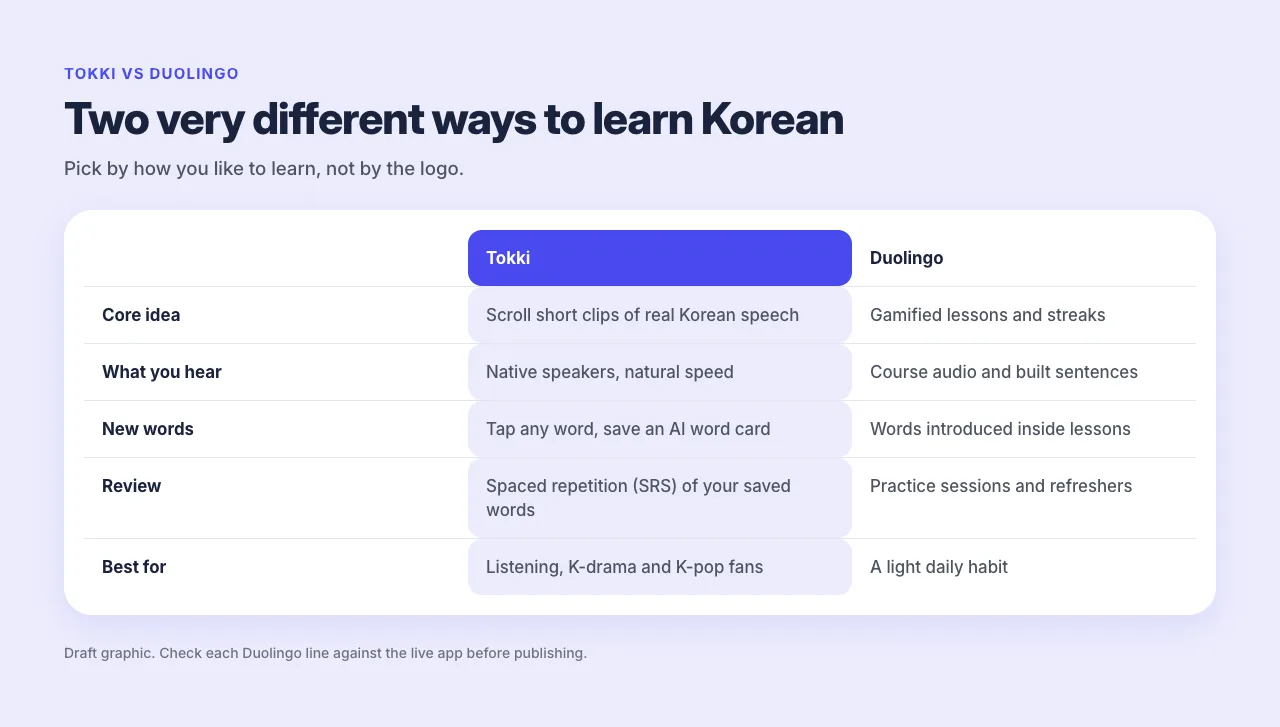 Pick by how you like to learn, not by the logo.
The short version: Duolingo builds a daily habit with lessons it writes for you. Tokki builds listening with Korean that was made for Korean speakers. You hear natural speed from the first clip, and the words you save are the ones you heard.
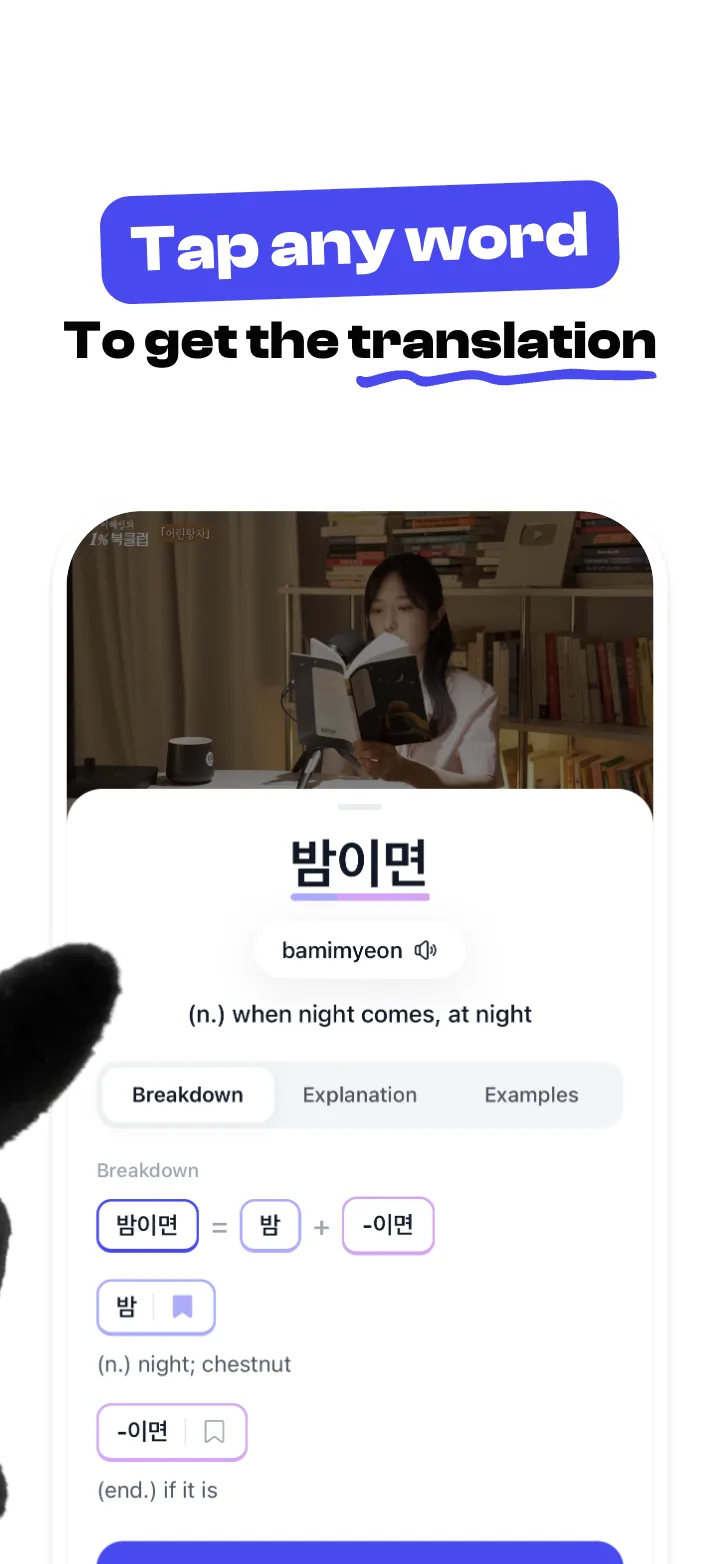 Tap any word to see what it means and save it for review.
They work well together. Keep your Duolingo streak for the basics, and spend a few minutes a day in Tokki so your ear gets used to real Korean.
Try Tokki free: learn Korean from short clips of real speech.
Which one should you pick?
- You are brand new. Learn the alphabet first with our guide to how to read Hangul. Then Duolingo or LingoDeer for a daily path.
- You can do the lessons, but real Korean is too fast. Tokki.
- You want grammar explained. LingoDeer for a game-like course, TTMIK for depth.
- You want to speak. Pimsleur, then a tutor when you want someone to answer back.
- You want vocabulary for a trip. Memrise.
For a wider list, including free options, see the best apps to learn Korean in 2026. Already using TTMIK or LingoDeer and want something different? Read TTMIK and LingoDeer alternatives.
Frequently asked questions
Is Duolingo Korean enough to become fluent?
No, not on its own. Duolingo Korean is a good start for Hangul, basic words, and a daily habit, and the course is free. Fluency also needs hours of listening to natural Korean, deeper grammar, and real conversation. Pair Duolingo with an app for real listening, like Tokki, and a course or tutor for grammar and speaking.
What is the best free alternative to Duolingo for Korean?
LingoDeer has the most useful free start: the alphabet, all of Unit 1, and the travel phrasebook are free. Memrise has a limited free version with native-speaker videos. Tokki, Pimsleur, and Talk To Me In Korean have 7-day free trials, and TTMIK's trial is on the yearly Standard plan. TTMIK's podcast and YouTube lessons are also free.
Can I use Duolingo and Tokki together?
Yes, and it is a good pair. Duolingo gives you short structured lessons and a streak. Tokki gives you real Korean clips where you tap any word, save it, and review it later. Do your Duolingo lesson, then watch a few Tokki clips to hear the same kind of words at natural speed.
Is LingoDeer better than Duolingo for Korean?
For grammar, yes. LingoDeer was built for Asian languages, and its notes explain Korean particles and sentence endings in more depth. Duolingo is better as a free daily habit, since its whole course is free and LingoDeer's full course needs a membership. Many learners use both.
Try Tokki
If you finish your Duolingo lesson and still cannot follow real Korean, download Tokki. Watch a clip, tap the words you do not know, and review them before they slip. Your first 7 days are free, on iPhone and Android.